

Reviewed · WALKING TOURS
Nairobi Down Town & Walking City Tour
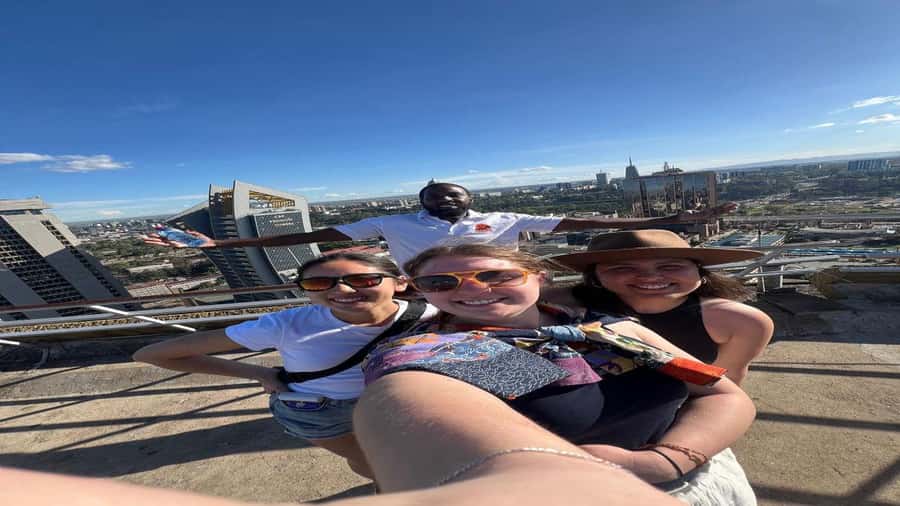
Nairobi’s downtown can feel like a maze at first, so this 3-hour walking tour is a smart way to get your bearings fast. You cover major landmarks on foot and finish with a shot at a 360-style aerial view from the KICC tower.
I especially like the stop at Jeevanjee Gardens, because it is both a calm break spot and a living Nairobi story. I also enjoy how the route threads together culture and everyday city commerce at City Market, then grounds it all with major heritage at Jamia Mosque.
One thing to consider: the KICC rooftop/tower experience has an extra entrance fee (not included), so factor that into your budget and plan for a little waiting time inside.
Key highlights worth knowing

- Private English guide with pickup and drop-off from your base area
- Jeevanjee Gardens (a donated public property) and a lunch-break hangout with a local rule about smoking
- City Market for 1930s-era architecture and quick browsing of masks, paintings, garments, and more
- Jamia Mosque on Banda Street, founded 1902 and built 1925 to 1933, a regional Islamic landmark
- Kenyatta International Conference Centre (KICC) tower views, with an optional 5 USD entrance fee
- Walking pace with short pass-by moments, then a longer anchor stop at City Market and KICC
Getting your bearings: what this Nairobi CBD walk actually does for you

This is one of those tours that makes a new city easier, not harder. In just 3 hours, you move through Nairobi’s central business district area with a private English-speaking guide, so you spend less time guessing and more time noticing.
The value is partly the price, about $10 per person, but it is really the structure. You get a mix of things to look at (gardens, market, big religious architecture, civic buildings) and time to ask questions. That combination matters in Nairobi, where context changes how you see a street corner.
Because it is a private group, you are not stuck moving at someone else’s pace. Your guide can slow down if you are taking photos, or keep you moving if the heat is getting to you. I like that the tour uses a “walk, stop, look, then walk again” rhythm, rather than forcing everything into one long slog.
More City Tours in Nairobi
- Nairobi Historical Walking City Tour
★ 5.0 · 258 reviews - Nairobi City Walking Tour with Traditional Kenyan Lunch
★ 5.0 · 106 reviews - Nairobi: Private 4-Hour City Tour
★ 4.5 · 68 reviews
Jeevanjee Gardens: the donated public space and the quick Nairobi lesson
You start at Jeevanjee Gardens, a rare kind of place in a city center. This is described as the first and only private property donated to the public by Abdulahi Jeevanjee, and it shows in how people use it day to day.
This park is not just scenic. It is practical. It plays a big role for people during the lunch-hour break, which means you get a real sense of Nairobi rhythms. If you want to understand how locals breathe for a moment in a busy CBD, this is a good place to stand and watch.
There is also a very Nairobi detail that your guide can explain. The gardens provide a public smoking zone, because smoking is illegal just about anywhere else. It sounds small, but it is the kind of local rule that helps you understand how cities keep order.
Practical tip: if you are sensitive to noise or crowds, arrive with an open mind. This is a public resting spot, so it can feel active even when it is not a “touristy” scene.
City Market on Koinange Street: a 1930s building built for trading

Next up is City Market, and you actually get time here, about 20 minutes. That is enough to browse, ask questions, and get a feel for what the market sells without turning it into a rushed shopping panic.
The building is described as monumental and dating to the 1930s, which matters because you are not just walking past shops. You are stepping into a place that has been part of Nairobi’s trading life for decades.
What I like most is the mix of categories. You will see cultural souvenir items such as masks, paintings, and garments, plus different selling sections that include meat selling. So even if you are not buying anything, the market gives you a quick education in how the city supports everyday needs and keeps culture on display at the same time.
A small caution: City Market is a place where people are selling. Keep your bargaining instincts calm and respectful. If you want photos, ask first, and expect that you might get pulled into conversations that turn into sales pitches.
The street corridor: Biashara Street and Moi Avenue as your Nairobi orientation

Between stops, you will pass by Biashara Street and Moi Avenue. These pass-by moments might sound like filler, but they are how your guide helps you connect the dots.
This is where walking tours pay off, because Nairobi streets are easier to read when someone points out landmarks in sequence. You start to recognize where the religious buildings sit, where the commercial buildings cluster, and how the main avenues act like rails through the city.
If you are visiting for the first time, these “pass-by” sections are where you learn the most, even though nothing seems to pause. You begin to understand the geography of the center, so later, when you are on your own, your routes make sense faster.
Practical tip: wear comfortable shoes. This is a downtown walk, and Nairobi’s sidewalks can vary block by block.
More Walking Tours in Nairobi
- Nairobi: Historic and Modern Highlights Walking Tour
★ 4.8 · 703 reviews - Nairobi Downtown Walking Tour
★ 4.7 · 208 reviews - Nairobi Walking Tour: Downtown & City Tour
★ 4.8 · 32 reviews - Day tour to Hells Gate, Lake Naivasha and Crescent Island Walk
★ 5.0 · 26 reviews
Jamia Mosque on Banda Street: heritage you can feel in the architecture
One of the most striking pass-by stops is Jamia Mosque on Banda Street. It is positioned as a major heritage site right in the CBD, and the details are specific, which makes your guide’s explanation more than just storytelling.
The mosque is described as an important center of Islamic practice across East and Central Africa. It is also an architectural landmark, with a history that includes two key dates: founded by Syed Maulana Abdullah Shah in 1902, and constructed between 1925 and 1933.
I like this stop because it changes your view of the city. Nairobi is often presented through modern images, but you see how deep religious and community structures go. This is not “background history.” It is part of the city’s identity, anchored in a real building that people still connect with.
If you want to be respectful with your time, keep your movement smooth. Don’t block pathways, and be mindful about photos. If you want to take a close look, ask your guide what is appropriate first.
McMillan Memorial Library, Bank of India, and the Kenya National Archive: civic Nairobi at street level

Your walk also passes several major buildings that act like Nairobi’s civic résumé. You go by McMillan Memorial Library, the Bank of India, and the Kenya National Archive.
Even though these are pass-by stops, they matter for two reasons.
First, they give you a sense of the city’s “official” core. When you see cultural institutions like a library next to financial institutions like a bank, you feel the different functions that share the same downtown space.
Second, your guide can point out how these buildings sit in relation to the rest of the route, including the big landmark of Jamia Mosque and the later highlight at KICC. When the sequence clicks, it feels like someone turned on a map layer in your brain.
If you are the type who likes understanding why cities are shaped the way they are, this portion will feel satisfying. If you prefer only photo stops, you might wish you had more time here. But remember, the tour is designed to fit everything into a total 3-hour window.
KICC: getting Nairobi’s aerial view in 360, and what costs extra

The tour’s big payoff is the stop at Kenyatta International Conference Centre (KICC) on Harambee Avenue. The tower is described as an icon of Nairobi, and it is your ticket to a 360-style aerial view.
There is also an on-site historical detail your guide can explain. The area includes a statue of Kenya’s first President, and KICC is noted as one of the first major buildings constructed after independence. That means you are not just going up for a photo. You are also standing at a landmark meant to represent a national moment.
Timing is important here. You are scheduled for a KICC stop, and the duration at the center is listed as about 30 minutes. Also, the KICC entrance fee is 5 USD and is not included.
So here is how to plan it:
- If you want the rooftop/tower viewpoint, bring the extra 5 USD.
- If you would rather not pay, you can still appreciate the grounds and the landmark architecture, but you might miss the main view experience.
From a value standpoint, the extra fee is the main variable in this tour. Still, even with it, you are not paying for a full-day excursion. You are paying for orientation plus one standout skyline moment.
Price and value: $10 for a private downtown tour, with a realistic extra
At roughly $10 per person for a 3-hour private walk, this tour is aimed at affordability without skipping the key ingredients: a professional guide, mineral water, and pickup and drop-off.
You should think of it like this: you are paying for someone to do the “mental map work” for you. Instead of you spending hours researching or wandering randomly, the guide points out what matters at each stop.
Where you need to budget extra is simple. The tour states the KICC entrance fee is 5 USD. Everything else, like water and the guide time, is included.
Also note that food and drinks are not included. That matters if you are the type who gets hungry quickly after walking in warm city weather. In a city center, it is easy to find snacks, but you should plan so you are not deciding on the fly during your short tour window.
Cultural expectation check: the tour description signals cultural learning tied to Bomas of Kenya, including stories about cultural dances and home styles. Even if you are not sitting in a full performance venue, you should come ready to learn through explanations linked to what you see on the route.
Who should book this Nairobi downtown walking tour

This tour fits you best if you:
- Want a first-time orientation to Nairobi’s central area
- Like historical landmarks mixed with everyday city life
- Prefer a private guide over joining a larger group
- Have a short schedule and want a skyline moment at KICC
It is less ideal if you:
- Hate walking and want long indoor time only
- Want a deep, slow museum-style experience at every stop
- Do not want to pay the extra KICC entrance fee
If you are traveling alone, this still works well because you get a private group experience. If you are traveling with friends, it also works because you can keep the pace and questions shared.
Should you book this Nairobi Down Town and Walking City Tour?
Yes, if your goal is to understand Nairobi’s center quickly and leave with more than just photos. The mix of Jeevanjee Gardens, City Market, and Jamia Mosque, then finishing at KICC for the aerial view, is a solid formula for a short visit.
The strongest reason to book is the human part. The tour is built around a professional, English-speaking guide who can explain what you are seeing in plain terms. That is what turns a list of places into a real experience.
Only make the call after you decide on the KICC viewpoint. If rooftop access matters to you, bring the 5 USD. If not, you can still enjoy the landmark setting, but your “why” for booking shifts.
FAQ
How long is the Nairobi Down Town and Walking City Tour?
The tour is 3 hours long.
How much does the tour cost?
It is priced at $10 per person.
Does the tour include pickup and drop-off?
Yes, pickup and drop-off are included.
What is included in the price?
A professional guide, mineral water, and pickup and drop-off are included.
Is the KICC entrance fee included?
No. The KICC entrance fee is 5 USD and is not included.
Where do we stop during the tour?
You will pass by Jeevanjee Gardens, Biashara Street, Moi Avenue, Jamia Mosque, McMillan Memorial Library, Bank of India, and the Kenya National Archive, and you will stop at City Market and at Kenyatta International Conference Centre (KICC).
What language is the live guide?
The live tour guide is in English.
Is food included?
No. Food and drinks are not included.
Can I cancel for a refund?
Yes, there is free cancellation if you cancel up to 24 hours in advance for a full refund.
Recently reviewed from Nairobi
- Amboseli Day Trip from Nairobi★ 4.5 · 3 reviews
- Ngare Ndare Day Trip★ 5.0 · 3 reviews
- Nairobi city tour★ 4.5 · 3 reviews
- Day Trip To Crescent Island And Hells Gate National Park★ 5.0 · 3 reviews
- Crescent Island Day Tour From Nairobi★ 5.0 · 3 reviews
- 1-Day Amboseli Safari★ 5.0 · 3 reviews
- 13-Day Uganda Mgahinga Gorilla Trek, Maasai Amboseli Park★ 5.0 · 3 reviews
- 4 days group joining budget safari to Maasai Mara only★ 5.0 · 3 reviews
Walking Tours, compared.

Walking Tour Through Old Town Mombasa and Fort Jesus
Read our review →

Nairobi Walking tour:Explore History Culture and Traditions
Read our review →

Nairobi City Walking Tour with Traditional Kenyan Lunch
Read our review →

Browse the lists this tour appears in