

Reviewed · KIBERA
Nairobi Guided Tour to Kibera Slums
Kibera is one of Nairobi’s most talked about places, but what makes this tour interesting is that it focuses on everyday life, not shock value. In a small-group setting, with a guide like Calvin or Kelvin doing the talking, you get a real sense of how people build community, trade, learn, and solve problems in place.
I especially love two parts. First, the visit to a biogas plant that uses human waste to power homes, which makes the idea of innovation feel practical, not theoretical. Second, the chance to see how curio makers turn materials into ornaments at the Curio workshop, including those bone craft details you would never see from a distance.
One drawback to consider: you are stepping into a working neighborhood where daily routines keep moving, including around homes and facilities. Go in with sensitivity, and expect the experience to feel personal, not polished.
Key points at a glance

- Biogas energy you can see up close, including how it powers homes in the area
- Curio workshop crafts, including ornaments made from animal bones
- Schools and daily services like nursery schools, water vending, and shower shops
- A guided home visit where you can ask questions about day-to-day life
- Maximum 7 travelers, so the guide can actually answer your questions
- Hotel pickup and drop-off, which matters in Nairobi timing
A half-day in Kibera, and what you really take away

This is a guided, half-day experience that trades distant viewpoints for on-the-ground context. You start with a drive into the community area, then move through a mix of development projects, school spaces, market life, and local facilities. The goal is to help you understand what daily life looks like, and why community-led projects can be the difference between survival and stability.
I like that the tour does not treat Kibera as a single story. Instead, it shows how different pieces connect. Education shows up at nursery schools. Small businesses show up at open-air markets and day-to-day vending. Practical technology shows up at the biogas plant. Even the craft work tells you something about resourcefulness and culture.
There’s also a human part. This is not a silent walking safari. You have time to ask questions, and you’re encouraged to talk with the guide so you can translate what you’re seeing into something meaningful.
More of Kibera:
- Nairobi: Explore Kibera Slum with Local Guides
★ 4.9 · 365 reviews - Kevins Kibera Slum Tours
★ 5.0 · 213 reviews - Nairobi: Kibera Slum storytelling tour with a Local
★ 5.0 · 185 reviews
From Ngong Road into Soweto Village and the Curio workshop
Your morning begins with pickup and a drive through Ngong Road, then you continue into the community area where you’ll visit Soweto Village homesteads. This matters, because it sets the tone. You’re not dropping into Kibera for a quick photo and leaving. You’re being brought through the approach, then shown specific places where residents manage daily life.
One standout stop is the Curio (handcrafts) workshop. This is where you’ll see artisans making ornaments out of animal bones. The first thing I would tell you to expect is that it looks like craft work and workbench problem-solving, not a spectacle. The bones are treated as material to shape into something saleable and meaningful, and that shift in perspective is kind of the point of the tour.
If you care about design and local enterprise, this is a great section. You can learn what people make, why they make it, and how that fits into household economies. If you prefer your experiences purely visual, you may find yourself wishing for more time to watch and ask questions. The good news is that the whole experience is paced for a small group, not a rushed herd.
Nursery schools, water vending, and the routines you notice when you slow down
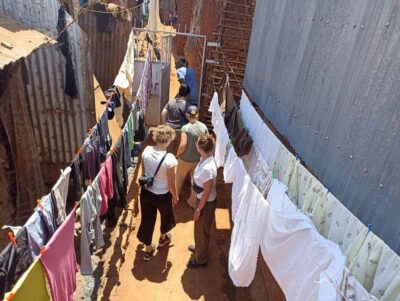
After the workshop, the tour keeps you moving through spaces tied to everyday needs. You’ll visit nursery schools, then pass by areas where you can see how people manage basics like water supply and personal bathing services, including a water vendor and a shower shop.
This is one of my favorite parts of the tour, because it’s observational in a useful way. You’re not just ticking off a list. You’re noticing how a community keeps functioning. And once you see those routines, you start understanding why logistics and service access matter so much.
As you pass by, you may also encounter other residents going about chores while you’re walking and meeting your guide. That can feel awkward at first if you’re not used to neighborhood-level interactions, but it’s also where the tour becomes real. If you treat the moment like a respectful conversation with your guide and keep your movements calm, it usually clicks into place.
A practical note for you: this part can be visually busy and emotionally intense, especially if you’re coming from a place where services are more separated. The guide helps you keep perspective, so rely on them. Ask what something is for, and what it means in daily life.
Stepping into a typical home and asking good questions

One of the strongest reasons to book this tour is the chance to enter a typical Kibera house. This is where your understanding stops being abstract. You get a direct view of domestic space and daily living realities, and you’re given time to feel welcome and ask questions about day-to-day life.
This is also where you should bring the right mindset. Don’t treat the house as a set. Treat it as a home, and treat your questions like you’re trying to learn, not judge. If you come in thinking you’ll be able to fix anything, you’ll probably leave frustrated. If you come in thinking you’ll listen and learn, you’ll leave with clearer understanding.
I also appreciate that the guide does the translation work between what you’re seeing and what it means. A strong guide matters here. In the feedback from past visitors, guides like Calvin and Kelvin get credited for being professional, friendly, and genuinely knowledgeable. That matters because home visits need careful handling, and you want someone who can guide the conversation in a respectful way.
More days out of Nairobi:
- Nairobi National Park Half-Day Tour; Free Wi-Fi connection
★ 5.0 · 878 reviews - Nairobi: National Park & Optional Elephants & Giraffe Center
★ 4.8 · 874 reviews - NAI NAMI: Nairobi Storytelling Tour with Street Children
★ 5.0 · 792 reviews - Nairobi National Park Half-Day Game Drive
★ 4.5 · 738 reviews
The biogas plant that turns waste into power for homes

The tour includes a walk to see a biogas plant that uses human waste as its raw material. The really specific detail is that it’s described as the only one of its kind in Africa, and that it powers about 200 homes in the area.
This stop tends to land differently than the markets and houses. It reframes the word slum. It’s easy to picture deprivation, and that’s part of the picture, but the biogas plant shows a different angle too: the presence of solutions built for local conditions.
What I love about this is how tangible it feels. You’re not just hearing about infrastructure. You’re seeing a system and connecting it to household energy. It makes you think about public health, waste management, and energy access as a single problem, not separate topics.
If you’re the type of traveler who likes practical stories, this is your moment. Ask your guide how the plant fits into local life, and how the community experiences the difference it makes. Even if you don’t go deep into the technical details, you’ll leave with a stronger understanding of why local problem-solving can be powerful.
Price and logistics: is $90 good value for a 6-hour small-group tour?

At $90 per person for about 6 hours, the first question is always value. Here’s what helps justify the price.
You get a professional Kibera guide, plus hotel pickup and drop-off, which in Nairobi can save real time and stress. The group size is capped at 7 travelers, which is important. With a smaller group, you get more conversation time and fewer bottlenecks at key stops like the home visit and the workshop.
Admission is listed as free as part of the experience, so you’re not paying extra just to see the main sites. You’ll also be getting a mobile ticket, which makes the day feel smoother.
What’s not included is lunch and any gratuities, plus souvenir photo options are available to purchase. That means you should plan for a meal on your own, and decide in advance whether you want to budget for photos.
If you’re weighing this against generic tours that only show a neighborhood from the outside, this one’s value is in access and interpretation. It gives you a guide-led route through development spaces, education areas, local services, a home visit, and a biogas system.
Safety and respect on a community-focused tour

Safety is the kind of thing you should ask about before you go, and this tour has built-in reassurance through the way it’s guided. Past visitors have described the experience as super safe, and the tone from those comments consistently points to professional guidance and clear handling.
Still, your job is to keep it respectful and calm. Here are a few simple ways to do that without overthinking it.
- Keep your camera use thoughtful. If you want souvenirs photos, consider using the offered photo options instead of taking lots of unprompted shots.
- Ask questions through the guide. This keeps things organized and avoids putting people on the spot.
- Be ready for a real neighborhood feel. This is day-to-day life, not a museum.
If you can handle an authentic setting with sensitivity, you’ll probably feel more comfortable than you expect.
Who should book this Kibera tour, and who might not love it

This tour is a strong fit if you want more than sightseeing. You’ll likely enjoy it if you like cultural context, practical community projects, and guided conversations that help you understand what you’re seeing.
It can also be a good choice for families, with the note that children must be accompanied by an adult. It’s best for adults and kids who can follow a guided plan and stay respectful inside homes and school-adjacent spaces.
You might want to skip this if you’re looking for a light, purely scenic outing. The visit to a typical home and the look at human waste to energy systems can be emotionally heavy. It’s not about being dramatic. It’s about being honest, and your reaction matters.
Should you book the Nairobi Guided Tour to Kibera Slums?
I think you should book it if you want a guided, small-group look at Kibera that explains how daily life works and how community projects operate. The standout ingredients are the biogas plant, the Curio workshop with bone ornaments, the nursery schools, and the time to ask questions during a home visit. Those are not just stops, they’re learning moments.
You might pass if you want a casual, low-emotion tour, or if you’re uncomfortable with intimate, real-world conversations. If that sounds like you, save it for another trip when you can give it your full attention.
Overall, if you come with respect, curiosity, and patience for a neighborhood rhythm, this is the kind of experience that actually changes how you see Nairobi.
FAQ
How long is the Nairobi Kibera Slums guided tour?
It runs for about 6 hours.
What time does the tour start?
The start time is 8:30 am.
What is included in the price?
You get a professional Kibera guide, plus hotel pickup and drop-off.
Is lunch included?
No, lunch is not included.
Is admission included?
Admission is free as part of the experience.
What is the group size limit?
The maximum group size is 7 travelers.
Are children allowed on the tour?
Children can join, but they must be accompanied by an adult.
Do I get a ticket on my phone?
You receive a mobile ticket.
What is the cancellation policy?
Free cancellation is available up to 24 hours before the experience start time for a full refund.
Are souvenir photos included?
Souvenir photos are available to purchase.
Recently reviewed from Nairobi
- Amboseli Day Trip from Nairobi★ 4.5 · 3 reviews
- Nairobi city tour★ 4.5 · 3 reviews
- Ngare Ndare Day Trip★ 5.0 · 3 reviews
- Day Trip To Crescent Island And Hells Gate National Park★ 5.0 · 3 reviews
- Crescent Island Day Tour From Nairobi★ 5.0 · 3 reviews
- 1-Day Amboseli Safari★ 5.0 · 3 reviews
- 13-Day Uganda Mgahinga Gorilla Trek, Maasai Amboseli Park★ 5.0 · 3 reviews
- 4 days group joining budget safari to Maasai Mara only★ 5.0 · 3 reviews
Kibera, compared.




Kibera Slum Tour with Local Social Entrepreneurs
Read our review →


Browse the lists this tour appears in